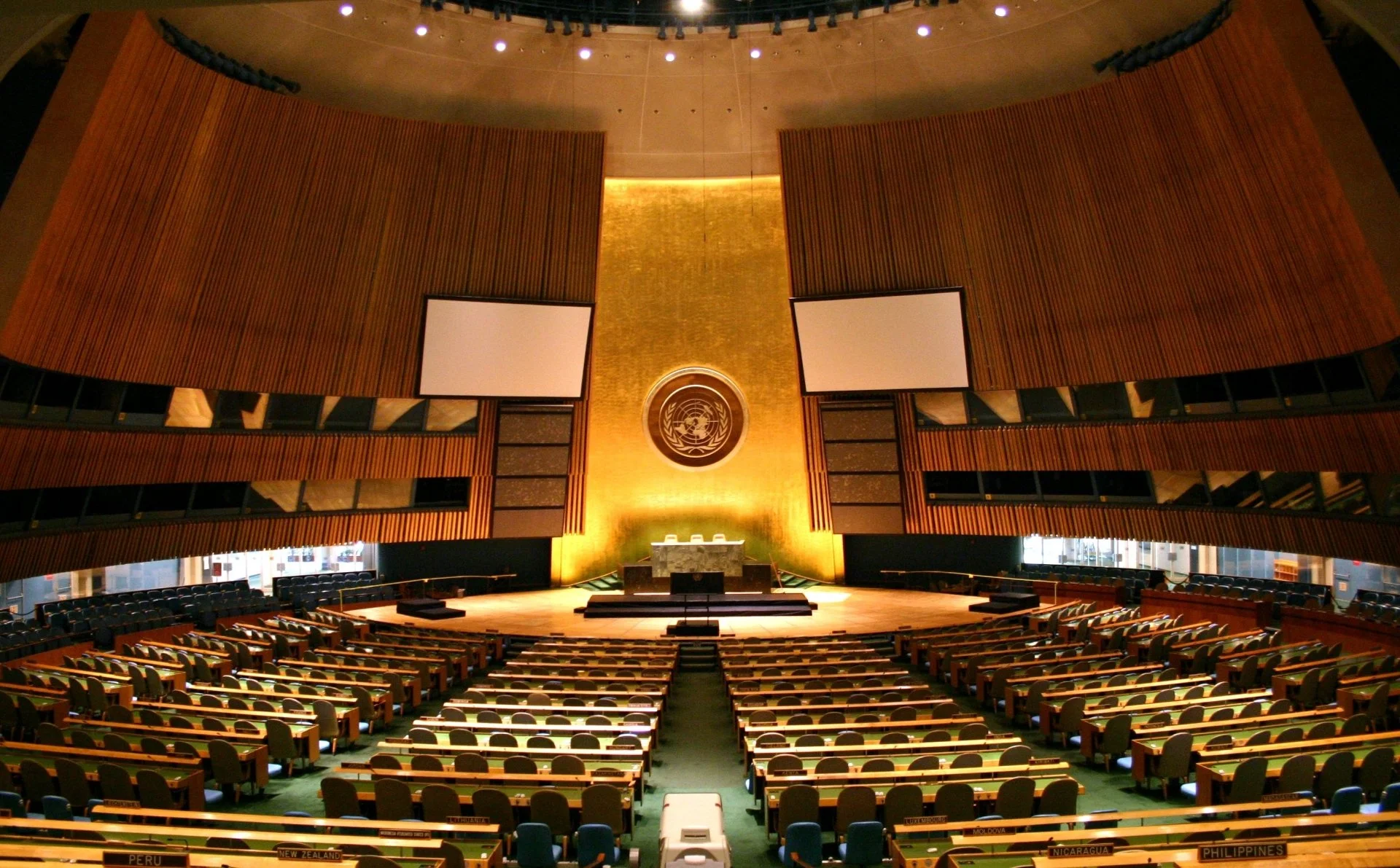
United Nations General Assembly 1 (DISEC) Details
What Is the United Nations General Assembly 1 (DISEC)?
The Economic and Social Council Committee, commonly referred to as ECOSOC, is one of the 6 organ bodies in the United Nations. It serves as the central platform for discussing and coordinating economic, social, and environmental issues and initiatives, it plays a key role in advancing sustainable development and international cooperation. The committee focuses on a wide range of topics ranging from reducing poverty, education, gender equality, public health, climate action, and humanitarian missions. Unlike the United Nations Security council, the committee does not possess any power to enforce resolutions, yet it strives to promote dialogue and coordination among member states. ECOSOC is composed of 54 member states elected by the general assembly for staggered 3 year terms. ECOSOC adopts resolutions and recommendations that are non-binding but help shape international policies and help guide the work of the wider United Nations system.
Topics
Ensuring that AI-driven military systems comply with international human rights law.
Artificial intelligence is rapidly transforming modern warfare. From autonomous drones, and targeting algorithms to AI assisted battlefield decision making, states are increasingly integrating machine driven systems into their armed forces. The promise of AI in military contexts is significant, promising greater precision, reduced human risk, and faster operational response. However, these advancements raise profound, and unresolved questions under international humanitarian law, and international human rights law.
Current legal frameworks, including the Geneva Conventions, and Additional Protocols, were written with human decision makers in mind. They require combatants to distinguish between civilians, and combatants, apply proportionality in attacks, and exercise fair human judgment. Whether an autonomous system can satisfy these requirements, and who bears legal responsibility when it does not, still remains deeply contested. The International Committee of the Red Cross (ICRC) has called for new legally binding rules governing autonomous weapons systems, a position echoed by many states but resisted by major powers wary of constraining their technological edge.
Safeguard sensitive military information against terroristc cyber attacks.
As military infrastructure becomes increasingly digitised, the vulnerability of defence networks to cyberattacks has grown into one of the most urgent security challenges of the 21st century. Terrorist organizations, and non-state actors have demonstrated growing sophistication in their cyber capabilities, targeting defence databases, communications infrastructure, weapons systems, and classified intelligence. A successful breach of sensitive military data can compromise operational security, endanger personnel, expose intelligence sources, and even grant hostile actors access to weapons technologies.
The challenge is compounded by the nature of cyberspace itself, attacks can be launched anonymously, across borders, and at minimal cost, making attribution, and deterrence extraordinarily difficult. Existing international frameworks, including the UN Charter's provisions on the use of force, and the Tallinn Manual (a non-binding academic guide to cyber operations under international law), offer partial guidance but fall short of a comprehensive legal regime.